Particle size is one of the most important quality parameters in modern manufacturing. Whether producing food, pharmaceuticals, cosmetics, paints, chemicals, or biotechnology products, reducing and controlling particle or droplet size directly affects product stability, appearance, viscosity, bioavailability, shelf life, and overall performance.
Among various particle size reduction technologies, the rotor-stator homogenizer has become one of the most widely used solutions for producing fine emulsions, stable suspensions, and colloidal systems. By generating intense mechanical forces inside the mixing head, it disperses, deagglomerates, and homogenizes materials within a very short processing time.
This article explains how rotor-stator homogenizers reduce particle size, which factors determine the final particle size distribution, and what particle sizes can realistically be achieved in different applications.
What Is Particle Size Reduction?
Particle size reduction is the process of breaking larger particles, droplets, or agglomerates into much smaller and more uniformly distributed sizes.
The benefits of smaller particle sizes include:
Improved product stability
Better dispersion of solid particles
Higher reaction rates
Increased surface area
Better texture and mouthfeel
Enhanced bioavailability in pharmaceutical formulations
Improved color development in pigments and coatings
Depending on the product, particle size may be expressed in:
Millimeters (mm)
Micrometers (µm)
Nanometers (nm)
Industrial homogenizers are generally used when particle sizes need to be reduced from the micrometer range into the submicron or even nanometer range.
How Does a Rotor-Stator Homogenizer Reduce Particle Size?
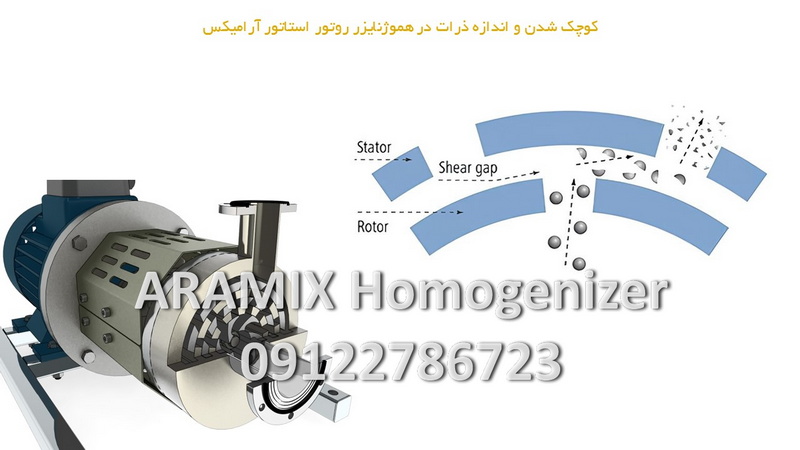
The working principle of a rotor-stator homogenizer is relatively simple but extremely effective.
Inside the mixing head, a high-speed rotor rotates within a stationary stator at speeds typically ranging from 1,500 to 3,000 rpm, although higher rotational speeds are available in specialized systems.
As material passes through the narrow gap between the rotor and stator, it is exposed to extremely high velocity gradients and intense mechanical forces. These forces continuously break droplets, disperse solid particles, and eliminate agglomerates until a more uniform particle size distribution is achieved.
Unlike conventional agitators, a rotor-stator homogenizer does not simply mix materials; it actively creates microscopic mechanical stresses that reduce particle size.

Mechanisms Responsible for Particle Size Reduction
Several physical mechanisms work simultaneously inside the homogenizer.
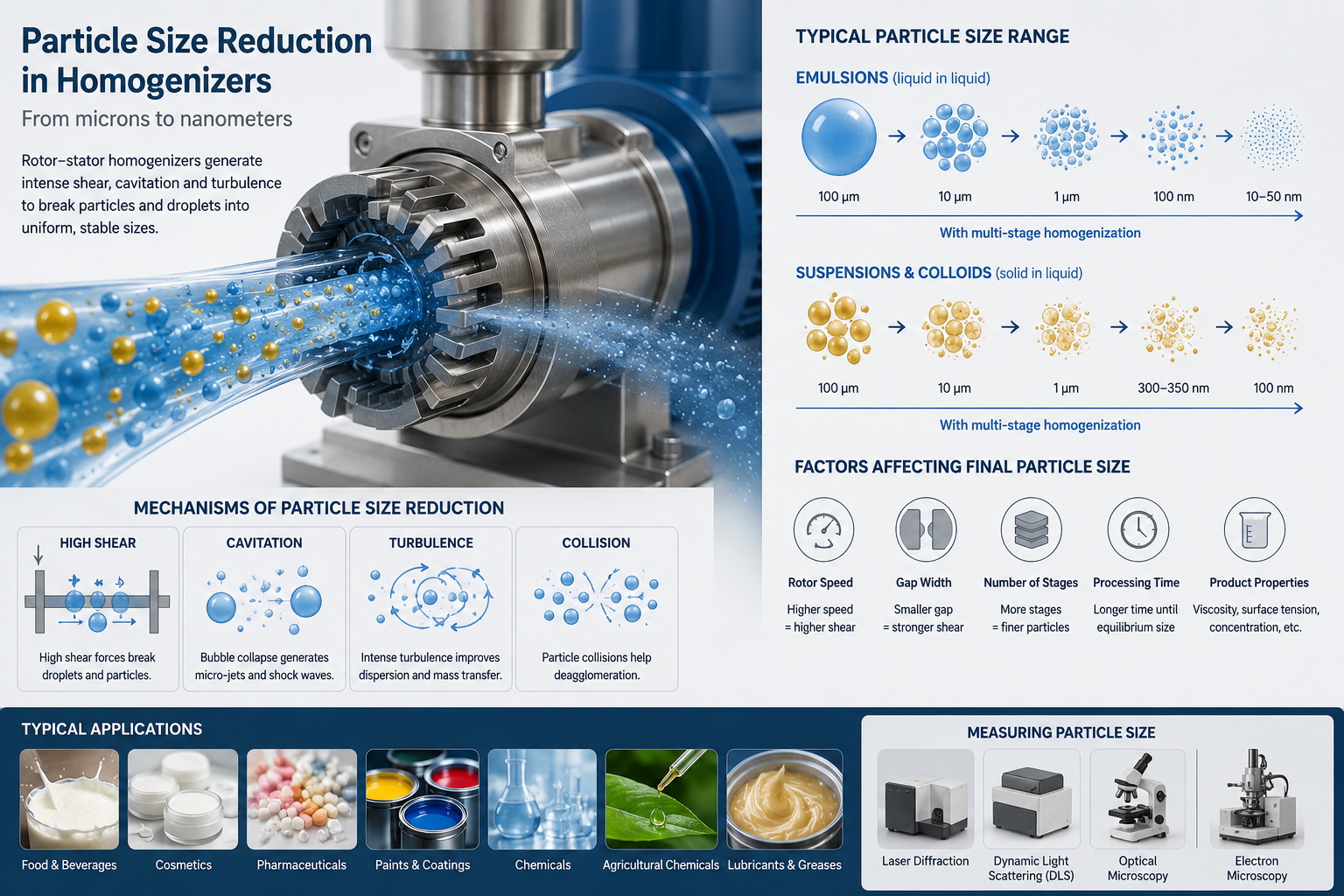
1. High Shear Forces
Shear is the primary mechanism responsible for particle size reduction.
As the rotor rotates at high speed, the fluid experiences intense shear stress while flowing through the narrow rotor-stator clearance.
Large droplets and particle clusters cannot withstand these forces and are progressively broken into much smaller particles.
The higher the shear rate, the finer the resulting particle size.
2. Cavitation
Rapid pressure changes inside the mixing head create microscopic vapor bubbles.
When these bubbles collapse, they generate localized shock waves and micro-jets capable of breaking droplets and weak particle agglomerates.
Although cavitation is not the dominant mechanism in every formulation, it significantly contributes to particle size reduction in many liquid systems.
3. Turbulence
High-speed circulation creates intense turbulent flow.
Large eddies continuously break into smaller vortices, transferring energy throughout the fluid and improving dispersion uniformity.
4. Particle Collision
Solid particles repeatedly collide with one another and with the rotor-stator surfaces.
These repeated impacts help separate loosely bonded particles and improve dispersion.
Factors That Determine the Final Particle Size
Achieving a specific particle size depends on much more than the homogenizer itself.
Several process variables influence the final result.
Product Properties
The physical properties of the material have the greatest influence.
Important factors include:
Viscosity
Surface tension
Density
Particle hardness
Particle shape
Initial particle size
Concentration of solids
Highly viscous materials generally require more processing energy than low-viscosity liquids.
Rotor-Stator Design
Different rotor-stator geometries produce different shear levels.
Parameters such as:
Slot design
Hole diameter
Number of stages
Number of rows
Flow pattern
all affect the energy transferred to the product.
Multi-stage rotor-stator heads usually generate finer emulsions than single-stage designs because the product passes through several high-shear zones.
Rotor Speed
Increasing rotational speed increases shear rate.
In many applications, higher tip speeds result in smaller droplets or particles, although excessive speed may increase temperature or consume unnecessary energy.
Rotor-Stator Gap
The clearance between the rotor and stator is one of the most critical design parameters.
A smaller and precisely manufactured gap generates stronger shear forces and produces finer particle sizes.
This is why precision CNC machining and tight manufacturing tolerances are essential for high-performance homogenizers.
Processing Time
Particle size generally decreases with longer processing time until an equilibrium size is reached.
Beyond that point, additional mixing often produces little improvement.
Particle Size in Emulsions
An emulsion is a mixture of two immiscible liquids, such as oil and water.
Instead of reducing solid particles, homogenization breaks one liquid into microscopic droplets that remain dispersed in another liquid.
Typical applications include:
Milk
Cream
Mayonnaise
Cosmetic lotions
Pharmaceutical emulsions
Silicone emulsions
Industrial lubricants
The final droplet size depends on:
Oil concentration
Emulsifier type
Viscosity
Processing energy
Homogenizer design
With optimized formulations and high-performance multi-stage rotor-stator homogenizers operating in recirculation mode, submicron emulsions are routinely achievable.
In specialized pharmaceutical formulations such as liposomal dispersions, particle sizes in the 25–50 nm range may be obtained after process optimization, although the achievable size depends strongly on formulation chemistry and processing conditions rather than the homogenizer alone.
Particle Size in Suspensions and Colloids
Suspensions differ from emulsions because they contain solid particles dispersed in a liquid rather than liquid droplets.
Examples include:
Paints
Ceramic slurries
Pigment dispersions
Agricultural chemicals
Fertilizers
Greases
Battery materials
Mineral slurries
Because solid particles are mechanically stronger than liquid droplets, they are generally more difficult to reduce in size.
Consequently, the final particle size in suspensions is often larger than in emulsions.
For many pigment dispersions processed with multi-stage rotor-stator homogenizers, particle sizes around 300–350 nm can be achieved under optimized conditions. However, actual performance depends on pigment hardness, formulation, residence time, and processing energy.
Can Rotor-Stator Homogenizers Replace Bead Mills?
In many applications, yes.
Rotor-stator homogenizers are increasingly replacing bead mills for products that do not require aggressive grinding of extremely hard particles.
Advantages include:
Lower maintenance
No grinding media contamination
Faster cleaning
Lower operating costs
Continuous processing capability
Shorter production cycles
However, for extremely hard inorganic materials requiring particle sizes well below 100 nm, bead mills or high-pressure homogenizers may still provide better results.
The most suitable technology depends on the product formulation and target particle size.
Why Particle Size Distribution Matters
Average particle size alone does not fully describe product quality.
Engineers also evaluate particle size distribution (PSD), which indicates how uniformly particles are dispersed.
A narrow distribution generally provides:
Better stability
More consistent appearance
Improved flow behavior
Better filtration performance
Reduced sedimentation
For this reason, modern quality control often measures parameters such as D10, D50, and D90, rather than relying on a single average particle size.
Measuring Particle Size
Several analytical techniques are commonly used to evaluate homogenization performance.
The most common methods include:
Laser Diffraction
Dynamic Light Scattering (DLS)
Optical Microscopy
Electron Microscopy (SEM/TEM)
Image Analysis
The appropriate measurement method depends on the expected particle size range and the characteristics of the material.
Conclusion
Rotor-stator homogenizers are highly efficient tools for reducing particle size in emulsions, suspensions, and colloidal systems. Their performance depends on a combination of high shear forces, cavitation, turbulence, and particle collisions, together with formulation properties and machine design.
The achievable particle size is influenced by viscosity, rotor speed, processing time, rotor-stator geometry, and manufacturing precision. While optimized systems can produce nano-scale emulsions and submicron pigment dispersions, the final particle size always depends on both the equipment and the formulation being processed.
Selecting the appropriate homogenization technology should therefore be based not only on the desired particle size but also on product characteristics, production capacity, and long-term process requirements. This approach leads to more stable products, higher production efficiency, and improved overall product quality.